


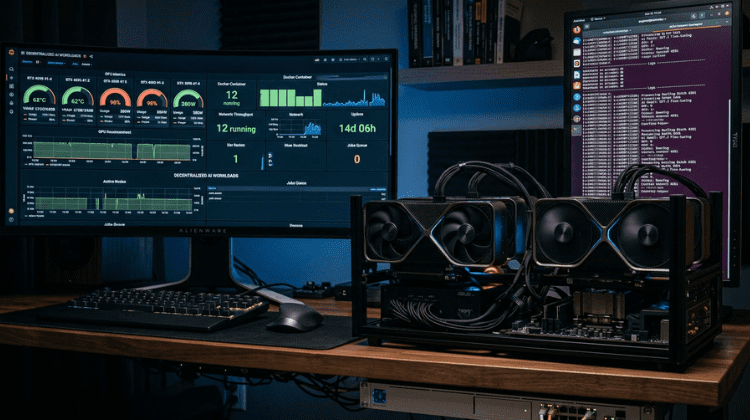
AI compute crypto — The New Economy of GPU Compute
The economics of GPU ownership have changed dramatically. Only a few years ago, most consumer graphics cards were purchased primarily for gaming or cryptocurrency mining. Today, artificial intelligence has transformed GPUs into one of the most valuable forms of digital infrastructure.
This shift created an entirely new market: decentralized AI compute. Instead of mining proof-of-work blocks, GPU owners can now rent computational power to networks processing machine learning workloads, AI inference, rendering tasks, and distributed cloud operations. This reflects the broader rise of crypto infrastructure, where useful compute resources are becoming more valuable than speculative hash power.
At the center of this transition is a simple reality. Modern AI models require enormous parallel compute resources, and centralized cloud providers cannot satisfy global demand alone. Decentralized compute networks emerged to fill that gap by aggregating consumer and enterprise GPUs into scalable infrastructure layers.
As a result, the profitability equation has changed. Success no longer depends purely on raw hash power. Instead, earnings are increasingly influenced by VRAM capacity, uptime reliability, thermal stability, networking quality, and deployment architecture.
Understanding how to position hardware within this environment is becoming essential for anyone exploring AI compute crypto opportunities in 2026.

Section 1 — Why AI Compute Changed the GPU Market
Traditional mining rewarded repetitive computational work. AI compute markets operate differently. Networks now prioritize GPUs capable of handling memory-intensive machine learning workloads rather than simple parallel hashing.
This distinction matters because AI applications place heavier demands on VRAM, bandwidth, and sustained operational stability. Large language models, inference systems, and AI rendering pipelines all require substantial memory allocation.
Consequently, GPU value is increasingly tied to real infrastructure utility rather than speculative mining efficiency. Consumer cards once optimized for gaming are now participating in decentralized AI ecosystems alongside professional compute hardware.
The growth of decentralized compute protocols reflects this broader shift. GPU owners are no longer simply miners. They are becoming infrastructure providers within distributed AI economies.
Section 2 — The VRAM Threshold That Dictates Earnings
One of the most important concepts in AI compute markets is VRAM capacity. In practice, memory size often determines whether a GPU qualifies for high-value workloads.
Cards with lower VRAM may still participate, but opportunities become more limited as model complexity increases. Many decentralized AI networks increasingly favor GPUs with 12GB to 24GB or more of memory capacity.
This creates clear performance tiers.
### Entry-Level Tier
* RTX 3060 12GB
* RTX 4060 Ti 16GB
These cards can participate in lighter workloads and smaller AI tasks, though earning potential remains moderate.
### Mid-Tier Infrastructure
* RTX 4070 Ti
* RTX 4080
* RX 7900 XTX
These systems provide stronger memory bandwidth and improved parallel processing capability, making them more attractive to decentralized compute networks.
### High-End Compute Tier
* RTX 4090
* NVIDIA A100
* NVIDIA H100
These GPUs dominate premium AI workloads because they combine massive VRAM pools with exceptional compute performance.
Within AI compute crypto ecosystems, VRAM acts almost like digital real estate. Larger memory capacity expands the range of workloads a system can process, directly affecting utilization and profitability.

Section 3 — The Operating System Reality Most Beginners Ignore
Many newcomers assume decentralized AI compute operates like traditional mining software. In reality, infrastructure deployment has become far more technical.
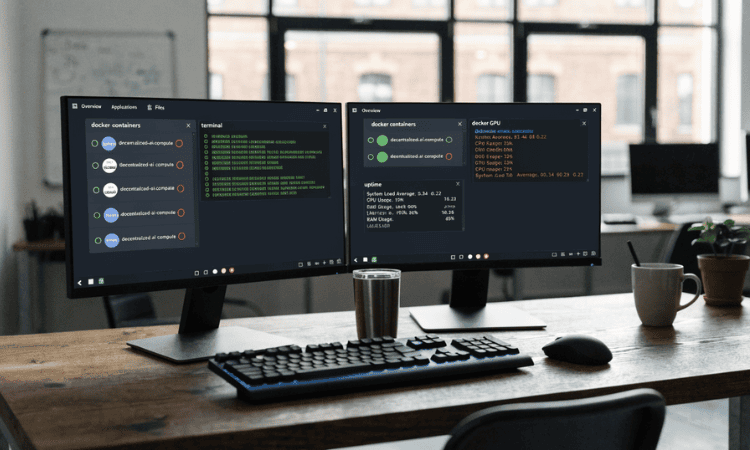
Most advanced GPU compute protocols rely heavily on Docker containers, Linux environments, and command-line deployment systems. As a result, operating system choice matters significantly.
Windows can still function in some scenarios, but long-term stability often improves under Ubuntu or WSL2 environments.
Linux-based systems generally provide:
* Better resource management
* Improved Docker compatibility
* Lower overhead
* More stable uptime performance
This transition represents one of the biggest hurdles for former miners entering AI infrastructure markets. The learning curve increases because operators must now manage containers, dependencies, networking configurations, and deployment scripts rather than simply launching mining software.
However, this complexity also creates opportunity. Many users avoid decentralized compute entirely because they are unwilling to learn infrastructure-level operations.
Those who adapt gain access to markets with significantly higher demand potential.

Section 4 — Choosing the Right Protocol for Your Hardware
Not every GPU fits every decentralized compute network. Hardware capability, networking quality, and operational goals all influence protocol selection.
Some systems are better suited for lightweight distributed workloads, while others excel in enterprise-grade infrastructure environments.
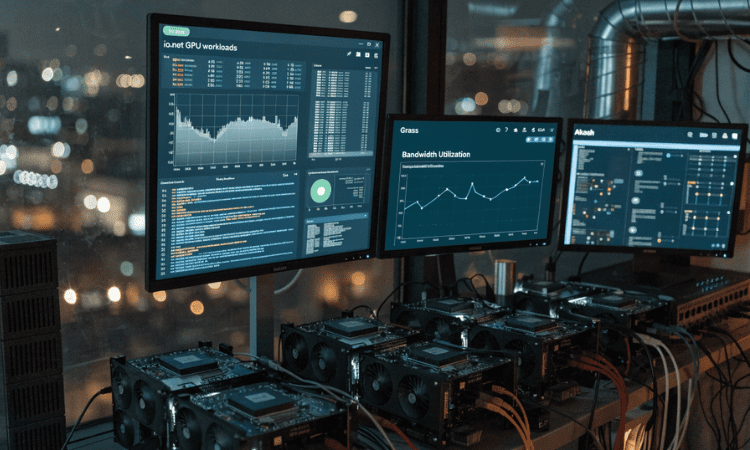
This is where infrastructure specialization becomes important. While io.net focuses heavily on consumer GPU clustering for AI workloads and Akash operates more like a decentralized cloud marketplace—as explored in our detailed analysis of **DePIN networks**—your hardware profile ultimately determines which ecosystem fits best. Our full comparison of DePIN networks breaks down how Grass, io.net, and Akash differ across infrastructure complexity and earning potential.
For example:
* Consumer gaming rigs often align naturally with io.net-style AI compute clustering.
* Enterprise servers with advanced networking and redundant infrastructure may fit Akash more effectively.
* Passive bandwidth systems such as Grass can operate simultaneously alongside GPU compute deployments.
This layered approach is increasingly common among advanced operators. Rather than relying on a single protocol, infrastructure providers diversify across multiple decentralized systems.

Section 5 — Why Uptime Is More Important Than Raw Power
Many operators focus exclusively on hardware performance while overlooking reliability metrics. In decentralized AI infrastructure, uptime often matters more than peak benchmark scores.
Protocols increasingly reward systems that maintain stable connectivity and predictable availability. A GPU disconnected frequently becomes less attractive to workloads requiring continuity and reliability.
This is why uptime scores approaching 99.9% have become critical across decentralized compute ecosystems.
Several factors influence uptime quality:
* Stable power delivery
* Effective cooling
* Reliable networking
* Proper operating system configuration
* Automated restart systems
Thermal management also becomes essential. AI workloads can sustain high utilization for extended periods, placing continuous stress on GPUs and cooling systems.
Professional operators increasingly approach decentralized compute like small-scale infrastructure businesses rather than hobby mining setups.

Section 6 — Networking and Latency Are Becoming Competitive Advantages
As decentralized AI expands, networking quality becomes increasingly important. Fast GPUs alone are not enough.
Low-latency fiber internet connections improve workload distribution and reduce synchronization delays across distributed compute clusters. Systems operating on unstable residential connections may experience reduced task allocation or lower reliability scores.
Bandwidth consistency also matters because decentralized AI workloads frequently involve large data transfers between nodes.
This changes the economics of participation. Geographic location, ISP quality, and routing stability now influence profitability alongside hardware specifications.
Over time, networking infrastructure may become just as valuable as GPU performance itself.

Section 7 — Building a Sustainable AI Compute Operation
The future of decentralized compute likely belongs to multi-layered operators capable of combining hardware efficiency, stable networking, and infrastructure reliability. As decentralized infrastructure expands, stable settlement systems shaped by stablecoin regulation may become increasingly important for compute marketplaces.
For beginners, the most practical approach often starts with existing gaming hardware. Learning Linux deployment, Docker management, and uptime optimization provides a foundation for gradual scaling.
More advanced operators may expand into:
* Dedicated GPU racks
* Rack-mounted server systems
* Redundant networking
* Multi-node clustering
* Enterprise cooling environments
The key difference between short-term experimentation and long-term profitability lies in operational discipline.
Successful infrastructure providers increasingly think like hosting operators rather than speculative miners.

AI Compute Crypto Conclusion — The New Infrastructure Economy
The rise of decentralized AI compute is redefining how GPUs generate value. Hardware once used primarily for gaming or mining is becoming part of a global infrastructure layer supporting artificial intelligence workloads.
This transformation changes what matters most. VRAM capacity, uptime reliability, deployment architecture, and networking quality now influence profitability more than raw speculation alone.
The shift also creates a new type of participant. GPU owners are evolving into decentralized infrastructure providers serving real computational demand.
As AI compute crypto ecosystems mature, the most successful operators will likely be those who combine technical competence with scalable infrastructure planning.
The mining era rewarded brute-force computation. The compute era rewards reliability, efficiency, and adaptability.
AI Compute Crypto More
Ready to scale beyond basic hardware setups?
Bookmark our complete deep-dive on the **2026 DePIN Trinity** to stay ahead of protocol changes and infrastructure trends.
Then drop your rig specifications in the comments:
* GPU model
* VRAM size
* CPU
* RAM
* Internet speed
* Operating system
We’ll help optimize your AI compute passive income strategy for 2026.
FAQ
**What is AI compute crypto?**
It refers to decentralized networks where GPU owners rent computational power for AI workloads instead of traditional mining.
**How much VRAM is recommended for AI compute?**
Most modern decentralized AI workloads favor GPUs with at least 12GB of VRAM, while 24GB cards perform significantly better.
**Can Windows run decentralized AI compute systems?**
Yes, but Ubuntu and WSL2 environments often provide better Docker compatibility and stability.
**Why is uptime important for AI compute?**
Protocols prioritize reliable infrastructure because AI workloads require stable continuous processing.
**Can old mining GPUs still be useful?**
Yes. Many RTX 30-series and newer GPUs remain highly valuable for decentralized AI compute networks.


