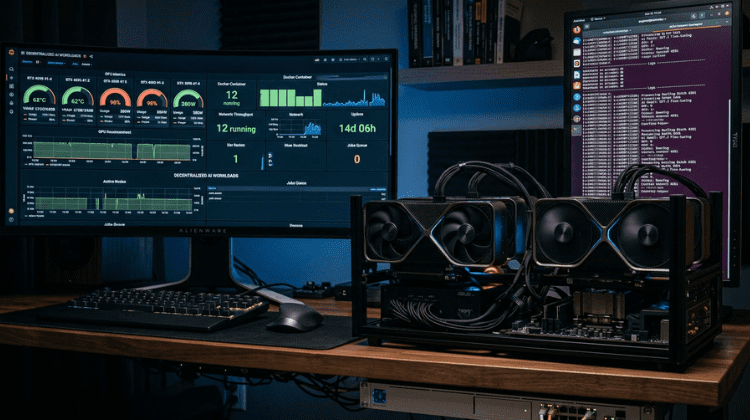
The Complete Hardware Guide: Renting Out Your GPU for AI Compute

The Complete Hardware Guide: Renting Out Your GPU for AI Compute

AI compute crypto β€” The New Economy of GPU Compute The economics of GPU ownership have changed dramatically. Only a few years ago, most consumer graphics cards were purchased primarily for gaming or cryptocurrency mining. Today, artificial intelligence has transformed GPUs into one of the most valuable forms of digital infrastructure. This shift created an entirely new market: decentralized AI compute. Instead of mining proof-of-work blocks, GPU owners can now rent computational power to networks processing machine learning workloads, AI inference, rendering tasks, and distributed cloud operations. This reflects the broader rise of crypto infrastructure, where useful compute resources are…
Read More
The 2026 DePIN Trinity: Grass vs. io.net vs. Akash Network

The 2026 DePIN Trinity: Grass vs. io.net vs. Akash Network

DePIN networks β€” The Death of Traditional Mining DePIN networks: Crypto mining is no longer defined only by hash power and proof-of-work rewards. Over the last few years, the economics of traditional mining have changed dramatically. Electricity costs increased, hardware margins tightened, and industrial-scale operations pushed smaller participants out of the market. At the same time, artificial intelligence and decentralized infrastructure created a new demand cycle. Instead of securing blockchains through repetitive computation alone, networks now require bandwidth, GPU compute, storage, and cloud infrastructure. The concept of β€œmining” is gradually evolving into something broader: supplying useful digital resources to decentralized…
Read More
Tokenized Assets: The Next Evolution of Financial Infrastructure

Tokenized Assets: The Next Evolution of Financial Infrastructure

Tokenized Assets β€” From Digital Assets to Real Ownership Crypto has long been associated with purely digital assets. Tokens were often created, traded, and valued within the boundaries of the crypto ecosystem itself. However, a new phase is emergingβ€”one that extends beyond native digital currencies and begins to intersect directly with traditional finance. At the center of this transition are tokenized assets. Rather than representing speculative instruments, these tokens reflect ownership of real-world value. Financial instruments, commodities, and even physical property can now be represented on-chain, allowing them to move through digital systems with greater efficiency. This shift signals a…
Read More
Crypto Infrastructure 2026: The Transformative Shift Beyond Speculation

Crypto Infrastructure 2026: The Transformative Shift Beyond Speculation

Crypto Infrastructure β€” The Crypto Story Has Changed Crypto is no longer defined solely by price charts and rapid market cycles. For years, attention revolved around volatility, speculation, and short-term gains. That narrative shaped public perception and attracted waves of participants driven primarily by momentum. However, the landscape has evolved. Markets remain volatile, yet the foundation beneath them has expanded. Payment systems, custody solutions, stablecoins, and on-chain financial tools now operate alongside speculative assets. As a result, the conversation has shifted. At the center of this transition is crypto infrastructure. The focus is gradually moving away from what can surge…
Read More
Stablecoin Regulation: The Hidden Power Shaping Crypto Markets Today

Stablecoin Regulation: The Hidden Power Shaping Crypto Markets Today

Stablecoin Regulation Stablecoins rarely dominate headlines, yet they sit at the center of nearly every crypto transaction. Trading, liquidity provision, and capital rotation all depend on their stability and availability. While attention often focuses on Bitcoin price movements or ETF flows, the underlying settlement layer tells a different story. Recent policy developments highlight this shift. The GENIUS Act in the United States is pushing forward detailed requirements around reserves, redemption, and disclosure. At the same time, Europe’s MiCA framework is enforcing licensing and transparency standards across issuers and exchanges. These changes are not isolated events. They reflect a broader transformation…
Read More
Crypto Regulation 2026: Structural Forces Reshaping Digital Markets

Crypto Regulation 2026: Structural Forces Reshaping Digital Markets

Crypto Regulation 2026 Bitcoin recently pushed above the $72,000 level, reinforcing a bullish tone across the broader crypto market. Analysts see the possibility of further upside if ETF inflows remain strong and risk sentiment stays supportive. Yet beneath the optimism lies a more complex structural environment. Weekend trading has already revealed thin liquidity conditions, where relatively small flows can amplify price swings across Bitcoin, Ethereum, and high-beta altcoins. At the same time, regulatory pressure continues to reshape the industry. The United States has struggled to finalize a comprehensive crypto bill after negotiations stalled between policymakers and large financial institutions. Meanwhile,…
Read More
Crypto Exchange Centralization: The Hidden Structural Risk in Markets

Crypto Exchange Centralization: The Hidden Structural Risk in Markets

Crypto Exchange Centralization Recent exchange errors and operational irregularities have reminded participants of an uncomfortable truth: decentralization at the protocol level does not guarantee decentralization at the market level. Trading volume remains concentrated, custody layers remain clustered, and liquidity flows through a narrow set of infrastructure providers. This concentration exposes a structural weakness. When capital, order routing, and asset storage depend on a handful of venues, stability becomes conditional. Markets may appear resilient during calm periods, yet fragility increases beneath the surface. At the center of this issue lies crypto exchange centralization. Despite narratives celebrating distributed networks, price discovery and…
Read More
Crypto Market Liquidity: The Illusion Beneath Stability

Crypto Market Liquidity: The Illusion Beneath Stability

Crypto Market Liquidity Bitcoin’s pullback into the mid-$60Ks has not triggered panic. Funding rates have turned negative, leverage has cooled, and traders appear cautious ahead of macro data. On the surface, markets feel stable. However, stability and strength are not the same thing. What appears orderly may actually conceal structural thinness. This is where crypto market liquidity becomes critical. Liquidity is often mistaken for price movement or trading volume. In reality, it reflects how easily assets can be bought or sold without materially affecting price. Depth, resilience, and bid persistence matter far more than short-term volatility. Today’s environment presents a…
Read More
Crypto Ownership Responsibilities: The Hidden Duties of Holding Digital Assets

Crypto Ownership Responsibilities: The Hidden Duties of Holding Digital Assets

Crypto Ownership Responsibilities Owning crypto is often framed as freedom. Control over assets, independence from intermediaries, and global accessibility are presented as advantages that set digital assets apart from traditional finance. Yet this framing leaves out a crucial dimension: responsibility. When individuals hold crypto directly, they assume roles that were previously handled by institutions, systems, and legal safeguards. Crypto ownership changes the relationship between users and their assets. There is no automatic protection layer, no default recovery mechanism, and no customer support desk at the protocol level. Decisions that once felt abstract now carry direct consequences. Mistakes are not inconveniences;…
Read More
Crypto Legislation Explained: How Laws Are Reshaping Digital Assets

Crypto Legislation Explained: How Laws Are Reshaping Digital Assets

Crypto Legislation Crypto has moved beyond experimentation. What began as an open, loosely governed technological movement has grown into a global financial and infrastructure layer touching millions of users, institutions, and governments. As adoption expands, legal clarity becomes unavoidable. This is where crypto legislation enters the pictureβ€”not as a sudden restriction, but as a structural response to scale. Unlike market cycles, laws do not move quickly or reverse easily. They reflect long-term concerns around consumer protection, systemic risk, taxation, and sovereignty. For crypto users, this means that understanding legislation is no longer optional. Legal frameworks now shape how platforms operate,…
Read More