


Hot Wallet vs Cold Wallet: Convenience vs Control
Crypto security becomes more complicated as your portfolio grows.
When someone buys their first small amount of Bitcoin or Ethereum, wallet security may seem like a secondary concern. The assets sit on an exchange or inside an app, the balance appears on the screen, and everything feels straightforward.
Over time, that changes.
A portfolio becomes more valuable. Perhaps you begin using decentralized applications, holding assets for several years, or moving cryptocurrency between different platforms. Suddenly, the question is no longer simply what to buy.
It becomes: **where should you keep it?**
That is where the **hot wallet vs cold wallet** decision becomes important.
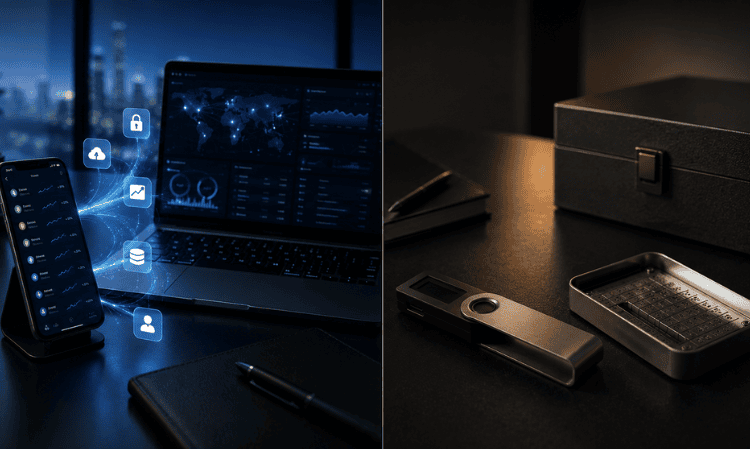
Both types of wallets can give you control over cryptocurrency. However, they approach security from very different directions. A hot wallet prioritizes accessibility. A cold wallet deliberately creates separation between your private keys and internet-connected environments.
Neither approach is automatically right for everyone.
Someone regularly interacting with decentralized applications has very different requirements from an investor who buys Bitcoin and intends to leave it untouched for five years. Likewise, a wallet containing a small amount for everyday transactions does not necessarily require the same security strategy as one protecting a substantial long-term portfolio.
Understanding **hot wallet vs cold wallet** security therefore requires more than asking which technology is safer.
You need to understand what you are protecting, how often you need access to it, and which risks you are willing to manage.
This guide breaks down those differences so you can choose a wallet strategy based on how you actually use cryptocurrency—not simply on which option sounds more secure.

What Is a Hot Wallet?
A hot wallet is a cryptocurrency wallet that operates in an internet-connected environment.
Mobile wallets, desktop applications, and browser-extension wallets generally fall into this category. They allow users to send, receive, and interact with digital assets quickly, which makes them particularly useful for regular cryptocurrency activity.
Their greatest advantage is convenience.
If you want to send cryptocurrency, interact with a decentralized exchange, connect to a Web3 application, or use a blockchain-based service, a hot wallet can make the process relatively simple.
You open the application, authorize the transaction, and continue.
That accessibility is precisely what makes hot wallets useful.
It is also what creates their primary security trade-off.
Internet Access Changes the Risk
A device connected to the internet interacts continuously with software, websites, applications, extensions, and networks.
Each interaction creates potential exposure.
This does not mean that hot wallets are inherently insecure. Well-designed wallets can include strong encryption and other safeguards. However, the environment surrounding the wallet matters.
Malware can infect a computer. A malicious browser extension can interfere with transactions. A convincing phishing website can imitate a legitimate service. Users can also unknowingly approve permissions that give malicious applications access to assets.
In many cases, the weakness is not the wallet technology itself.
It is everything around it.
Where Hot Wallets Excel
For everyday cryptocurrency activity, hot wallets can be extremely practical.
They are particularly useful for people who:
* regularly send cryptocurrency;
* interact with decentralized applications;
* participate in DeFi;
* manage NFTs or Web3 assets;
* need frequent access to smaller balances.
The key is understanding their role.
A hot wallet is better viewed as a working wallet than as a permanent vault.
Consider how people handle physical money. You may carry enough cash in your wallet for everyday needs, but you probably would not carry your entire savings with you everywhere you go.
The same principle can apply to cryptocurrency.
Keep accessible what you expect to use. Think more carefully about assets you intend to leave untouched for years.

What Is a Cold Wallet?
A cold wallet takes a different approach.
Instead of prioritizing constant accessibility, cold storage aims to keep the keys controlling cryptocurrency separated from internet-connected environments.
Hardware wallets are the most familiar example.
A hardware wallet is a dedicated physical device that protects private keys and performs sensitive signing operations without exposing those keys directly to the computer or smartphone being used.
The cryptocurrency itself is not stored inside the device.
Your assets remain recorded on the blockchain. The hardware wallet protects the credentials required to authorize movement of those assets.
That distinction is fundamental.
Why Offline Key Protection Matters
Imagine that malware has compromised your computer.
With an ordinary internet-connected environment, sensitive information stored or exposed on that computer could potentially become vulnerable.
A properly designed hardware wallet changes the situation.
The computer can prepare a transaction, but authorization takes place through the hardware device. The private key does not need to be handed over to the computer to complete the transaction.
This creates an important security boundary.
It does not make cryptocurrency impossible to steal. Nothing does.
However, it can dramatically reduce exposure to certain forms of remote attack.
The Trade-Off Is Convenience
Cold storage introduces friction deliberately.
You may need the physical device to authorize a transaction. You must protect recovery information carefully. Setup requires more attention than simply downloading an application.
For someone moving assets constantly, that additional friction can become inconvenient.
Also for someone holding cryptocurrency for several years, the same friction may be exactly what they want.
For readers who want to understand the ownership principles behind this approach, our guide to crypto self-custody explains how controlling your own private keys changes the relationship between you and your digital assets.
It creates distance between valuable assets and everyday online activity.
Who Benefits Most?
Cold storage tends to make the most sense for investors who:
* hold cryptocurrency for the long term;
* rarely move their primary holdings;
* have accumulated assets they would find financially painful to lose;
* want to reduce dependence on internet-connected wallets;
* are prepared to manage backups responsibly.
As the value of a portfolio increases, convenience often becomes less important than protection.
That is when cold storage starts becoming much more compelling.

Hot Wallet vs Cold Wallet: The Real Differences
At first glance, the distinction appears simple: one is connected to the internet and the other keeps critical keys offline.
In practice, the difference affects almost every aspect of how you manage cryptocurrency.

The most important difference is not simply technology.
It is **exposure**.
A hot wallet remains close to the environments where cryptocurrency activity happens. That makes transactions easier, but it also places the wallet closer to websites, applications, browser extensions, and other potential attack vectors.
Cold storage intentionally moves critical keys away from much of that activity.
This creates stronger separation, although it introduces another category of responsibility: physical security and recovery management.
Convenience Has a Security Cost
Every additional layer of convenience can introduce another point of interaction.
One-click connections, browser integrations, automatic approvals, and constant availability make digital assets easier to use.
They can also make mistakes easier to make.
Cold storage works partly because it slows the process down.
Having to connect or unlock a physical device and verify a transaction on its screen creates another opportunity to notice that something is wrong.
In security, friction is not always a disadvantage.
Sometimes friction is protection.

Which Wallet Is Actually Safer?
For long-term asset protection, cold storage generally provides a stronger security architecture because private keys can remain isolated from internet-connected devices.
But that statement needs an important qualification.
A cold wallet is only as secure as the way its owner uses it.
Someone can purchase an excellent hardware wallet and then undermine its protection by storing the recovery phrase in a cloud document, photographing it with a smartphone, entering it into a fraudulent website, or leaving the backup somewhere anyone can access.
Technology cannot compensate for every human mistake.
A Hardware Wallet Does Not Eliminate Phishing
This is particularly important.
Suppose an attacker convinces you to reveal your recovery phrase.
The attacker does not need your physical hardware wallet. The recovery information itself may provide what is needed to reconstruct access elsewhere.
Likewise, approving a malicious transaction can expose assets even when a hardware wallet is involved.
The device helps protect keys.
It cannot decide whether the person requesting a transaction is trustworthy.
Physical Security Matters Too
Cold storage also introduces risks that hot-wallet users may think about less frequently.
Hardware can be:
* lost;
* stolen;
* damaged;
* destroyed in a fire;
* forgotten;
* stored without an adequate recovery backup.
Fortunately, losing the physical device does not normally mean losing the cryptocurrency when recovery information has been secured correctly.
That is why backup strategy matters just as much as the wallet itself.
The Safest Wallet Depends on the Owner
There is an uncomfortable truth in cryptocurrency security:
**The safest wallet can become unsafe when the owner handles it badly.**
Good security therefore combines technology with disciplined behavior.
The wallet provides protection.
The owner completes the security system.
When a Hot Wallet Makes More Sense
Cold storage offers stronger isolation, but that does not make a hot wallet the wrong choice.
In fact, many cryptocurrency users need a hot wallet because digital assets are meant to be used, not simply stored.
The question is not whether hot wallets are good or bad. It is whether the amount of cryptocurrency kept inside them matches their purpose.
Everyday Transactions
Hot wallets are particularly useful when cryptocurrency moves regularly.
Someone who sends payments, transfers assets between platforms, or frequently receives cryptocurrency may find a hardware wallet unnecessarily cumbersome for every transaction.
A mobile wallet provides much faster access.
This convenience becomes especially valuable when cryptocurrency functions as working capital rather than long-term savings.
DeFi and Web3 Activity
Decentralized applications have made hot wallets an important part of the Web3 ecosystem.
Connecting to decentralized exchanges, lending protocols, NFT platforms, blockchain games, and other applications often requires a browser or mobile wallet.
However, this connectivity also creates risk.
Every smart contract interaction and wallet connection introduces another opportunity for something to go wrong. A malicious website may request dangerous permissions. A compromised application may imitate a legitimate platform.
For that reason, keeping an entire long-term portfolio inside the same wallet used for frequent Web3 experimentation may be unnecessary exposure.
Think of It as a Spending Wallet
A useful way to approach hot-wallet security is to compare it with the physical wallet you carry every day.
You keep enough money available for what you expect to need.
You do not normally carry your entire savings.
Cryptocurrency can be managed similarly.
A hot wallet can contain assets needed for transactions and Web3 activity, while larger long-term holdings remain somewhere less exposed.
That separation can reduce the consequences of a mistake without sacrificing everyday convenience.

When You Should Consider Cold Storage
There is no universal portfolio value at which someone suddenly needs cold storage.
For one investor, losing $500 would be painful. Another may comfortably keep several thousand dollars accessible for regular transactions.
A better question is:
**How damaging would losing these assets be to you?**
When the answer becomes “very,” stronger protection deserves serious consideration.
Your Assets Are Intended for Long-Term Holding
Cold storage makes particular sense for cryptocurrency that rarely moves.
If you purchased Bitcoin with the intention of holding it for several years, there is little advantage in keeping those assets constantly exposed to an internet-connected wallet.
Long-term holdings and everyday spending serve different purposes.
Their security strategies can therefore be different.
Your Portfolio Has Become Meaningful
Crypto portfolios often grow gradually.
Someone may begin with a small purchase and barely think about storage. Months or years later, market appreciation and additional purchases can turn that experimental position into a meaningful financial asset.
Yet the original security setup often remains unchanged.
Security should evolve alongside portfolio value.
The solution that was reasonable for $200 may no longer be appropriate when substantially more capital is involved.
You Rarely Need Immediate Access
Cold storage becomes easier to justify when immediate liquidity is unnecessary.
If you rarely trade or transfer your primary holdings, the additional steps required to access a hardware wallet are unlikely to create much inconvenience.
Instead, that friction becomes part of the security strategy.
Your assets remain accessible when genuinely needed without being constantly exposed during everyday online activity.
The Hybrid Strategy: Why You May Need Both
The debate between hot and cold wallets often creates the impression that investors must choose one and abandon the other.
In practice, using both can make more sense.
Each wallet can perform the job it handles best.
A simple structure might look like this:
**Exchange → Active trading**
**Hot wallet → Transactions, DeFi and Web3**
**Cold wallet → Long-term holdings**
This creates separation between different types of cryptocurrency activity.
Why Separation Matters
Imagine keeping your entire portfolio in one browser wallet.
You use that same wallet to connect to unfamiliar decentralized applications, sign transactions, experiment with new protocols, and store long-term Bitcoin or Ethereum holdings.
Every interaction potentially exposes everything.
Now imagine separating those activities.
A limited amount remains available for Web3 interactions. Long-term holdings sit behind a different security boundary and are rarely exposed.
One mistake no longer necessarily threatens the entire portfolio.
The Principle of Limited Exposure
This approach reflects a basic security principle: expose only what needs to be exposed.
The assets required for frequent transactions remain accessible.
Everything else receives stronger isolation.
It is similar to the way businesses separate operating accounts, reserves, and long-term assets instead of keeping every financial resource in one place.
Crypto investors can apply the same thinking.
A hybrid strategy does introduce more organization. Multiple wallets require careful record keeping and secure backups.
However, for larger portfolios, that additional organization can provide a valuable layer of risk separation.
Common Wallet Security Mistakes
Choosing the right wallet matters, but wallet choice alone cannot protect cryptocurrency.
Many serious losses begin with ordinary human mistakes.
Storing Recovery Phrases Online
A recovery phrase should never be treated like an ordinary password.
Saving it in email, cloud storage, screenshots, messaging applications, or unencrypted computer files can defeat much of the protection provided by a secure wallet.
Anyone obtaining the recovery information may potentially reconstruct access to the assets.
Offline storage remains the safer approach.
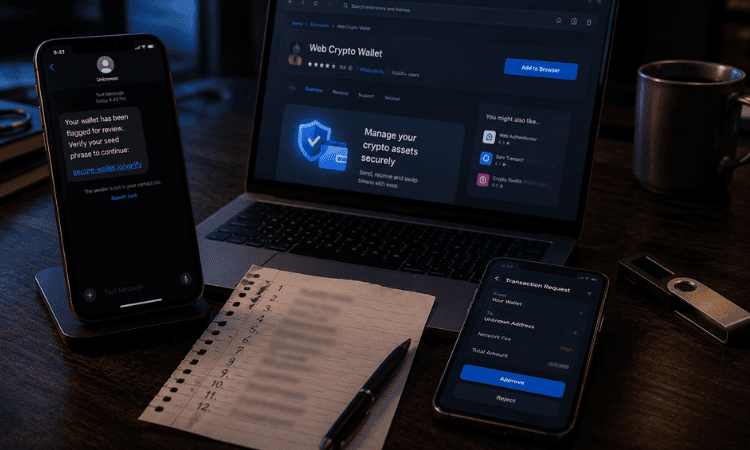
Entering Recovery Words Into Websites
Phishing attacks often create urgency.
A fake website may claim that a wallet requires verification, synchronization, an upgrade, or emergency recovery.
The user is then asked to enter the recovery phrase.
That should immediately raise suspicion.
Legitimate wallet security depends heavily on keeping recovery information private. Unexpected requests for those words should never be treated casually.
Installing Fake Wallet Software
Attackers can imitate legitimate applications and websites remarkably well.
Wallet software should therefore come from verified official sources.
Search advertisements, unsolicited links, social media messages, and unofficial download sites can lead users toward convincing copies designed to steal credentials.
Signing Without Reading
Web3 has normalized frequent wallet approvals.
That convenience can encourage users to click through transaction requests without examining what they are authorizing.
A hardware wallet cannot protect someone who knowingly approves a malicious transaction.
Always verify addresses, amounts, and transaction details before signing.
Buying Security Hardware From Questionable Sources
Hardware wallets should come from trustworthy sources with a verifiable supply chain.
Saving a small amount of money by purchasing an unknown or suspiciously modified device can introduce unnecessary risk into the very tool intended to improve security.
Never Testing Recovery
A backup that has never been verified is an assumption, not a recovery plan.
Users should understand the recovery process before an emergency occurs.
That does not mean repeatedly entering recovery phrases into devices or websites. It means following the wallet manufacturer’s official procedures and understanding exactly what would be required if the original device were lost or damaged.
These seemingly simple habits form part of the broader responsibilities of protecting cryptocurrency.
As explored in **The Most Expensive Mistake Crypto Owners Still Make**, security failures can permanently destroy value even when an investment decision itself was correct.
Choosing a Hardware Wallet
Once long-term holdings become valuable enough to justify cold storage, the next question is which hardware wallet to choose.
Price should not be the only consideration.
The device may eventually protect assets worth many times its purchase cost, so reliability and security deserve greater weight than saving a small amount upfront.
Examine the Security Architecture
Understand how the device protects private keys and signs transactions.
Modern hardware wallets may include dedicated security components designed to isolate sensitive operations from the connected computer.
The objective is simple: keep critical information protected even when the surrounding computer environment cannot be completely trusted.
Consider Recovery Options
Before buying any wallet, understand how recovery works.
Ask:
What happens if the device breaks?
What happens if it is lost?
Can the wallet be restored elsewhere?
What information must be protected?
A good security product should have a clear recovery process that users can understand before they need it.
Look Beyond the Number of Supported Coins
Supporting thousands of assets sounds impressive, but compatibility only matters if the wallet supports the assets you actually own.
For many long-term investors, security, reliability, Bitcoin support, Ethereum support, and compatibility with their preferred applications matter more than an enormous list of obscure tokens.
Evaluate Ease of Use
Usability is part of security.
A device that is unnecessarily confusing can encourage mistakes or cause users to avoid good security practices.
Screens, transaction verification, backup procedures, firmware updates, and wallet-management software should all be understandable.
Manufacturer Reputation Matters
A hardware wallet requires significant trust in its design and development.
Consider how long the manufacturer has operated, its approach to security research, software transparency, update history, documentation, and reputation within the cryptocurrency community.
Readers considering Trezor can use our **Best Trezor Wallet: Complete Security Guide for 2026** to compare the available models and determine which device best matches their portfolio and security requirements.
The objective is not to buy the most expensive wallet.
It is to choose a device you understand, trust, and will use correctly.

Hot Wallet vs Cold Wallet: Final Verdict
So, which one should you use?
The answer depends primarily on what you intend to do with your cryptocurrency.
A **hot wallet** is generally better suited to:
* frequent transactions;
* Web3 applications;
* DeFi activity;
* smaller working balances;
* cryptocurrency that needs to remain readily accessible.
A **cold wallet** is generally better suited to:
* long-term holdings;
* larger portfolios;
* assets that rarely move;
* investors seeking reduced online exposure;
* cryptocurrency intended primarily for preservation rather than everyday use.
For many investors, however, the strongest practical solution is not choosing one over the other.
It is using both intelligently.
A hot wallet can provide accessibility without holding the entire portfolio. Cold storage can protect long-term assets without interfering with everyday cryptocurrency activity.
That makes the **hot wallet vs cold wallet** question less about identifying a universal winner and more about assigning the right security level to the right assets.
As your portfolio changes, your security strategy should change with it.
A wallet setup that worked when you first bought cryptocurrency does not have to remain your setup forever.
Security should grow alongside ownership.

Frequently Asked Questions
Is a cold wallet safer than a hot wallet?
Cold wallets generally reduce exposure to remote attacks because private keys can remain isolated from internet-connected devices. However, security still depends on protecting recovery information, verifying transactions, and following proper backup procedures.
Can a hot wallet be hacked?
A hot wallet can be compromised through malware, phishing, malicious applications, stolen credentials, or other attacks targeting internet-connected environments. Strong security practices can reduce these risks, but they cannot eliminate them entirely.
Can a cold wallet be hacked?
No wallet should be considered completely invulnerable. Hardware wallets are designed to make remote compromise significantly more difficult, but phishing, exposed recovery phrases, malicious transactions, physical attacks, and user mistakes can still threaten assets.
More FAQ
Do I need a cold wallet for Bitcoin?
Not necessarily. The appropriate storage method depends on how much Bitcoin you hold, how frequently you use it, and how much responsibility you are prepared to manage. Cold storage becomes increasingly attractive for meaningful holdings intended to remain untouched for long periods.
How much crypto should I keep in a hot wallet?
There is no universal amount. A practical approach is to keep only the cryptocurrency needed for regular transactions or Web3 activity in a hot wallet while protecting assets that would cause significant financial harm if lost with stronger security.
Can I use a hot wallet and cold wallet together?
Yes. Many investors use both. A hot wallet handles regular activity, while a cold wallet protects longer-term holdings. This approach combines accessibility with stronger separation of risk.
What happens if I lose my hardware wallet?
Losing a hardware wallet does not necessarily mean losing the cryptocurrency it protects. If the recovery information has been backed up correctly, access can generally be restored using a compatible device or wallet. This is why protecting the recovery backup is as important as protecting the hardware itself.

